
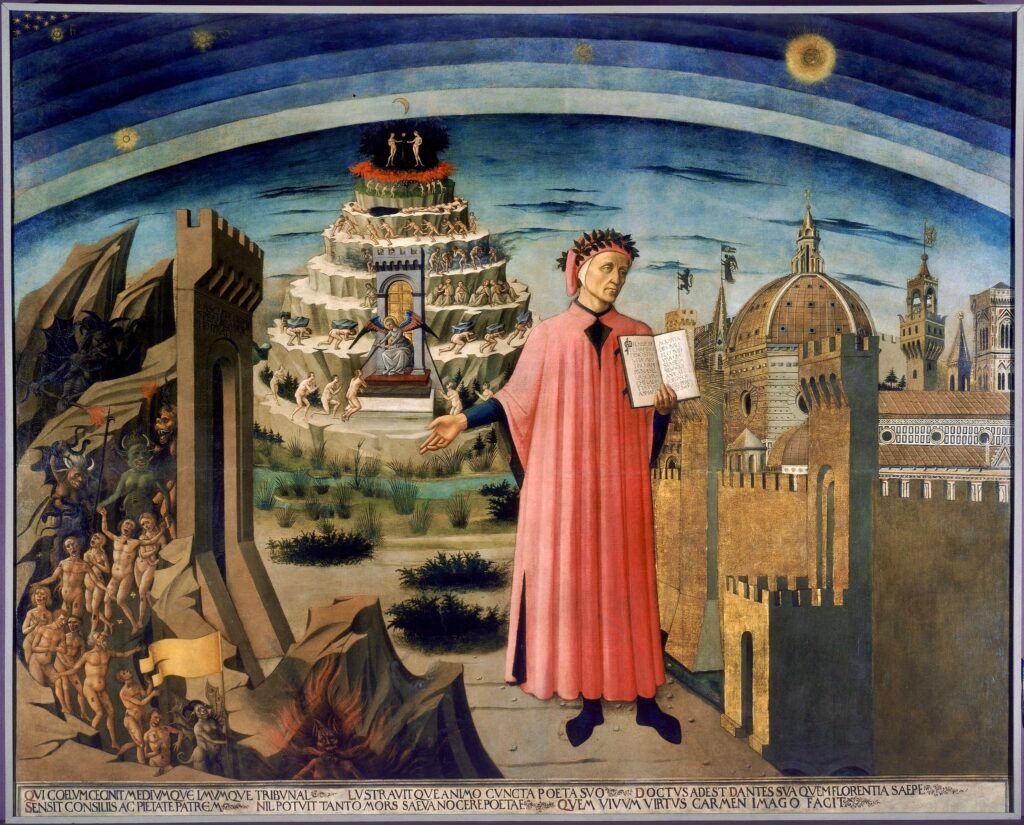
The Commedia presents itself as more than a poetic narrative; it asks to be read as a truthful account of reality. That claim is not easy to sustain. The narrator is neither a trained theologian nor an institutional authority; the poem is written in the vernacular, and poetry itself was often regarded as an unreliable medium for serious knowledge. The problem the text faces, then, is not only how to describe the afterlife, but how to persuade its readers that such a description reflects a real and intelligible order. Rather than relying solely on the force of its imagery or the immediacy of its experience, the Commedia increasingly grounds its narrative in the structure of the cosmos. References to celestial movement, planetary positioning, and the organization of the heavens do not function as decorative detail, but as a way of situating the journey within a system understood to exist independently of the narrator. This alignment matters because it allows the text to present itself as something more than an imaginative construction. It does not simply describe a world; it places that world within a framework governed by consistent and intelligible laws. As the journey progresses, this alignment becomes more precise, allowing the text to move from a subjective account toward one that appears grounded in a stable, intelligible, and external order. In doing so, the Commedia constructs a form of authority that does not depend entirely on belief in the narrator’s voice, but instead on its apparent correspondence with the structure of reality itself.
In Inferno, that alignment has not yet been fully established. The narrative unfolds in a space where access to celestial structure is limited and unstable, and this instability directly shapes how the journey is understood. The opening scene — “Nel mezzo del cammin di nostra vita / mi ritrovai per una selva oscura / […] / guardai in alto, e vidi le sue spalle / vestite già de’ raggi del pianeta / che mena dritto altrui per ogne calle” — situates the protagonist in confusion rather than clarity, and although the sun appears, it does not function as a reliable point of orientation (Inferno 1.1-18). It is visible but ultimately unreachable, blocked by the beasts that force the narrator back into darkness. This moment establishes a pattern that persists throughout the canticle. References to the sun’s movement do occur, marking the passage of time, but they do not form a consistent or explanatory framework for the journey. Instead, they remain occasional and secondary, unable to situate the narrative within a broader cosmological system. Hell itself is highly ordered, with its circles and punishments arranged according to a precise moral logic, yet that order remains enclosed within the realm rather than clearly connected to the structure of the universe as a whole. The result is a narrative that feels internally coherent but externally unanchored. Without a stable relation to celestial order, the journey remains grounded in immediate experience rather than in a system that guarantees its truth. This lack of consistent alignment with the heavens has important consequences for the text’s authority. The narrative can describe, categorize, and even judge, but it cannot yet fully demonstrate that its judgments correspond to a larger, intelligible system. The reader encounters a world that is vivid and structured, but not clearly integrated into a framework that extends beyond the realm it describes. The occasional presence of celestial reference is not enough to secure this integration, because it does not consistently organize or explain the narrative. As a result, the authority of Inferno remains provisional. It relies on the intensity of its scenes and the clarity of its internal logic, but it has not yet established itself as part of a system that exists independently of the act of narration. The canticle, therefore, reveals the limits of a narrative that is not fully aligned with cosmic order, setting up the need for a more stable framework in what follows.
The transition into Purgatorio marks a decisive shift in this dynamic. From the opening canto, the narrative situates itself explicitly within a recognizable cosmological framework, introducing precise references to celestial bodies that carry interpretive weight. The appearance of “lo bel pianeto che d’amar conforta” (Purgatorio 1.19) rising at dawn places the journey within a specific astrological configuration. Venus appears in Pisces, the sign of its exaltation, a condition associated with the heightened and refined expression of its influence. This detail is not incidental. The exaltation of Venus signals a form of order in which its qualities are expressed in their most coherent and elevated state, and this aligns with the narrative’s movement out of confusion and into clarity. The shift from Inferno to Purgatorio is not only spatial but structural, as the journey becomes increasingly oriented within a system that reflects intelligibility rather than obstruction. This alignment further extends beyond this single moment. The sky remains consistently visible, celestial cycles become legible, and time is structured through the regular movement of the heavens. The journey unfolds in relation to a system that exists independently of the narrator’s perception, creating a sense of coherence that was previously absent. The ascent of the mountain is organized by these cycles, with day and night regulating movement and rest, reinforcing the idea that the process of transformation is not arbitrary but governed by an external order. Astrology here functions as a framework that connects the narrative to a system understood to be real, allowing the text to present its account as aligned with the universe’s structure. This shift strengthens the poem’s authority by grounding its claims in a cosmological order that appears stable, consistent, and intelligible, rather than contingent on the narrator’s individual experience.
In Paradiso, this alignment becomes complete. The narrative no longer simply refers to celestial order but is fully structured by it, thereby fundamentally reshaping how authority operates within the text. The ascent through the planetary spheres reflects a hierarchical cosmology in which each level corresponds to a different degree of perfection and proximity to the divine. This structure determines not only the progression of the journey but also the meaning of what is encountered along the way. The cosmos is no longer a backdrop for the narrative but its organizing principle. The souls encountered in each sphere are not confined there but appear in ways adapted to the narrator’s capacity to perceive them, indicating that the representation is shaped by human limitation even as it participates in a larger system. The text acknowledges that what is seen cannot be fully expressed, yet this limitation does not weaken its claims. Instead, it reinforces the distinction between the narrative and the system it describes. The cosmological framework is not produced by language but precedes it, existing as the condition within which the narrative unfolds. As a result, the authority of the Commedia attains its fullest articulation in Paradiso. The narrative can no longer be characterized as relying exclusively on mimesis or symbolic figuration. Rather, it situates itself within a discursive framework that performs an ontological claim—that is, it asserts that the conditions of truth are structured independently of subjective mediation. The ordered movement of the celestial spheres, the systematic correlation between spatial location and metaphysical significance, and the cosmological hierarchy collectively foreground a referential system resistant to subjective hermeneutics. Astrology, in this methodological context, operates not as rhetorical embellishment but as the epistemic architecture through which the narrative produces and legitimizes knowledge. By fully integrating itself into this cosmological paradigm, the text relocates its authority from an expressive or authorial assertion to an ideologically inscribed position, grounding its truth claims within an external ontological order. This epistemological repositioning also reconfigures the reader’s interpretive stance. The narrative invites engagement not solely through aesthetic appreciation or imaginative projection, but through the recognition of a metaphysical structure that precedes and transcends narrative mediation. The authority of the text thus emerges through a paradigmatic shift: it is presented not as a construct of meaning, but as an act of disclosure, revealing a preexistent and invariant cosmic order.
By the end of the Commedia, the problem of authority has not been eliminated but redefined. What begins as a narrative grounded in disorientation and partial access to cosmic order becomes one that increasingly aligns with a structured, intelligible universe. This progression allows the text to move beyond the limitations of subjective experience and present itself as participating in a system that exists independently of the narrator. The increasing presence of astrological and cosmological structure is not merely thematic but foundational to this transformation. It provides a framework that stabilizes the narrative and gives its claims a sense of coherence and necessity. Rather than asking the reader to believe in a vision, the Commedia presents its account as unfolding within the same ordered cosmos that governs all existence. In doing so, it constructs an authority grounded not in persuasion alone, but in alignment with a system that defines truth itself, offering a model of narrative credibility that depends on structure rather than voice alone.