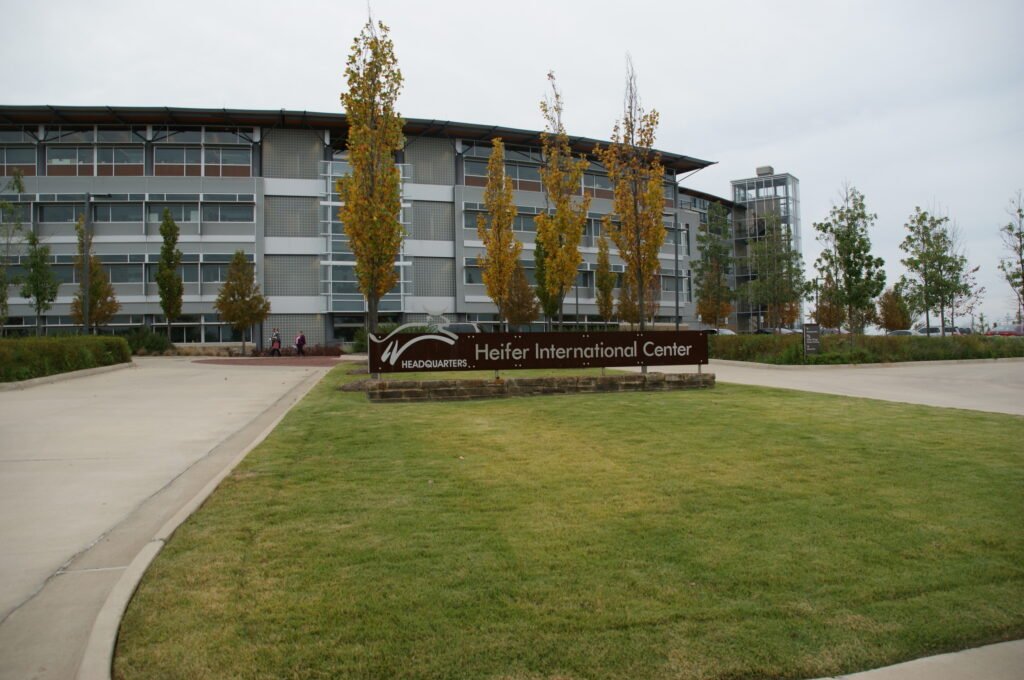
Heifer International’s ‘gift catalogue’ is filled with images of smiling, healthy children, thriving animals, and self-sufficient women, all set against green fields and lush forests. The program’s appeal to donors lies in its simplicity: the goats, heifers, and flocks of chicks are tangible evidence of how much the Global North cares for people like Shilpi, Rilli, and Kusu, women and mothers plagued by poverty and food insecurity in ambiguously ‘poor’ countries. You, too, can add a story to this list of well-fed children and animals and “create your own piece of history” for as little as $20 a month (Heifer International [HI], 2025). In reality, Heifer International’s Passing on the Gift Scheme places women in damaging industries, introduces water-intensive livestock onto water-impoverished regions, partners with capitalist corporations, and drops animals into the hands of slaughterhouses, promoting its hidden neoliberalist, modernized, and profit-driven philosophy.
In 1994, “a farmer from the Midwest and Church of the Brethren member,” Dan West, observed the limited impact of food donations during the Spanish Civil War. This lack inspired him to found Heifer International (HI) upon the notion of gifting families live animals, offering “a steady supply of nutritious food” and a sustainable source of income (HI, 2025). The Heifer-in-Trust model, also known as ‘Passing on the Gift’ in HI’s case, was born from this idea. Households across Africa are ‘loaned’ heifers or milking cows on the condition that the firstborn calf is repaid to another family, extending the nourishment and financial benefits of a milking cow across communities (Snow, 2019).
However, the company is influenced by the desire to push a neoliberal agenda onto the Global South, framing its intentions through the lens of modernization theory to justify its approach. Heifer International exemplifies Mudge’s three faces of neoliberalism. The NGO displays intellect in the form of self-reliance rather than loans, preaching the “non-political, non-cultural, machinelike” power of the market in alleviating poverty (Mudge, 2008). HI is bureaucratic in its market-driven policies of relying on NGOs rather than government aid but creating a sense of conditionality in ‘passing on the gift’; it operates as a charity that creates structures of self-sufficiency but forces participants into micro-enterprise-like, continued market participation. Clair and Anderson claim that HI’s “decidedly religious” and charitable background does not exempt it from “rely[ing] on a capitalist model” (2013). Finally, HI, at its core, preaches decentralization and reduction of state welfare, the political face. Their program shifts responsibility from the government to individuals, away from collective solutions and towards individual market participation.
The Heifer-in-Trust Scheme aims to develop communities according to Western ideals, modernization, and digitization. Escobar asks how “this peculiar way of seeing and constructing the world- ‘development’ -arise[s]?” (1997). From a post-structuralist perspective, Heifer International’s concept of development seeks to renovate and digitize countries by imposing the occident’s ways onto their strategy for reform. They promote Ribeiro’s “collective mobilization” notion by introducing new technology and infrastructure (Escobar, citing Ribeiro, 1997). In their own words, HI is “digitizing rural communities,” “commercializ[ing] products,” and creating “resilient rural economies” (2023). Heifer’s 2023 Annual Report describes how collaborating with micro-finance and banking institutions Duterimbere and Mastercard aid in “leveraging investment capital.” Dempsey highlights how HI’s micro-enterprise approach enforces a neoliberal environment, where the beneficiary’s success with the program depends on their ability to “engage with the market” (2009). She argues that, through self-surveillance, “interpersonal and familial networks are economized as loan collateral.”
In its ‘Hatching Hope’ campaign, HI partners with Walmart and Cargill- the largest public and private companies in the U.S., respectively (HI, 2022; Forbes, 2024). The initiative underscores two pillars of Hiefer’s development strategy: industrial meat production and women. Cargill, a dominating force in the international farming industry, has faced repeated scrutiny over food safety violations and enslaved child labour in the Global South (Mighty Earth, 2019). ‘Hatching Hope,’ like many other Heifer projects, presents itself as progressive by promoting women’s entrepreneurship, specifically in India’s egg and poultry industry (HI, 2022). Nevertheless, as Radhakrishnan puts it, these models lead to low-wage factories relying on the subordination of the very women they aim to empower (2015). Heifer prides itself on empowering women by thrusting them into the growing farming industry. However, this only allows the labour to remain feminized and inherently less worthy (Radhakrishnan). Their ties with extremely profit-driven, industrial farming corporations and their incorporation of women into this sector beg the question, is HI’s mission about charity or capital?
Heifer International’s signature initiative, ‘Passing on the Gift,’ damages communities that lack the infrastructure to support their gifts, most notably in its dairy cow handouts in Nepal. In 2023, HI facilitated the transfer of 101 Holstein dairy cows and 20 breeding bulls from South Korea to Nepalese dairy farmers (HI, 2023). HI flaunts the superior milk yield of the Korean cattle, 30 litres per day, rather than the 9 litres from the “unimproved” Nepalese cows. Their word choice is reminiscent of their aim to modernize the ‘Third World,’ where Escobar critiques, development is “the mechanism” that obliterates perceived differences (1997). Yet, Heifer overlooks Nepal’s acute water crisis. On top of an already disproportionate water scarcity, Gurung et al. suggest that rural households in Nepal spend hours collecting untreated water from springs or streams, making water-borne diseases rampant (2019). In 2023, the Kathmandu Valley demanded 485 million litres daily, “while production average[d] only 129 million litres” (Poudel & Shaw, 2025). Korean Holstein cows require around 114 litres of water daily (Jo et al., 2021), placing additional strain on an already dry source. Heifer implies that 30 litres of milk is more beneficial than 114 litres of clean water, an exchange omitted in their 2023 Annual Report.
Admittedly, Heifer International does select families based on criteria to ensure they have the means to support livestock. Among the requirements, Heifer recipients must have at least one acre of land for pasture, construct a shelter for the cow, keep it contained rather than free- grazing, and be deemed poor (Kabumbuli & Phelan, 2003). These conditions do little to justify the massive responsibility and strain of owning a dairy cow. Kabumbuli and Phelan determined that, in Uganda’s Mpigi district, farmers who received heifers “were already far better off,” in terms of education and land ownership, than those who applied and failed; “[s]o it was not necessarily clear how they qualified” at all. HI’s criteria rule out the poorest households, those who risk staining the NGO with “repeated failures.” Heifer’s imposing of market-driven self-sufficiency also has impacts on its communities. One cooperative lacked cold storage, milk testing facilities, and electricity, forcing farmers to compensate in membership fees, among other expenses. “[N]ecessary prerequisite[s] to the dairy industry” are ignored in Heifer’s criteria (Kabumbuli & Phelan).
A contributor to this negligence may lie in the charity’s use of Randomized Control Trials [RCT] to measure projects’ impact. Heifer self-admittedly “approache[s] data as practitioners” (2019). De Souza Leão and Eyal outline how, in developmental projects, RCTs examine short-term interventions and “are less consequential in terms of allocating of scarce resources” (2019); meanwhile, Heifer International prides itself in their use of RCTs to determine the practical use of their “limited resources.” With an economical approach, the NGO depends on causal identification and statistical analysis, creating the “hinge” of dual benefits between their philanthrocapitalist methodologies and randomistas, according to de Souza Leão and Eyal. Heifer benefits from the ideal results that the economic randomistas determine. Trusting solely the numbers makes it appear that their promising small actions provide long-term positive change. HI demonstrates libertarian paternalism, as outlined by the authors, emphasizing individual choice during trials while subtly nudging towards a preferred outcome. HI trains participants to evaluate themselves in “participatory self-review and planning,” adding another layer of partiality to their trials and tipping beneficiaries towards expressing gratitude for the program.
Animal welfare is also neglected in the ‘Passing on the Gift’ scheme. A study in Tanzania found that Heifer beneficiaries are uneducated and inexperienced in animal care; failure to maintain cattle nutrition and reproductive health leads to small herd size, “low fertility rates and high calf mortality,” affecting small farms and forcing rising milk costs (Green, 2017). Green reports that “milk yields are [..] between five and seven liters daily,” less than the ‘unimproved’ Nepalese cows. She describes a careless ambivalence toward the animals, with one beneficiary stating, “[t]he [Heifer] projects came, the Irish brought cows. But they are all gone now. Nothing’s left of that. The project is all finished.” Participants’ abandonment of the project is obvious. PETA’s investigative report determined that the charity is an “Advocate for the Meat Industry” (2018). Goat gifts are “usually added to those already kept by farmers and used for breeding.” Falsely assuming that communities have the infrastructure for a prosperous milk industry, Heifer fosters an economy where meat from animal gifts is more profitable than milk. PETA investigators encountered goats overly crowded into pens or “tied up so tightly they could barely move.” Owners shoved sticks into baby goats’ mouths to prevent them from suckling and ensuring maximum milk profits. Male goats “were pinned down and castrated without the use of any anesthesia.” In Alwar, Rajasthan, “[v]illagers, including those to whom Heifer International donates goats,” sell animals to slaughterhouses around 55 miles away, where carcasses are piled on bloody floors.
Heifer International omits these abuses in its promotional material. Holiday catalogues advertise the gifts available for purchase. Clair and Anderson draw attention to the “catchy, playful” titles in the gift guides and photos of well-fed children and animals, a dark contrast with reality; “no one milks a goat, sheers a lamb, or scoops up dung for fertilizer” (2013). Catalogues cater to HI’s apparent target donors. Neoliberal politics, according to Mudge, is oriented towards “business, finance and white-collar professionals” (2008), those who would appreciate Heifer’s “Gifts That Reduce Your Taxes,” including gifting stocks, retirement assets, or life insurance for tax reductions (2024). “Gifts That Pay You An Income,” like transferring money to a charitable gift annuity to receive life-long income, also fall under Mudge’s description of neoliberal tactics. Heifer blatantly indulges their ideal donor’s wishes.
In the face of a poverty so seemingly detached from one’s own situation, Heifer International takes advantage of the easily misguided Western mind. However, when developmental policies become increasingly tangled with neoliberalism, modernization, and the drive for profit, the line between charity and exploitation cannot help but blur. Heifer International claims to uplift communities, but forces burdens under the guise of gifts. Until development stops disguising itself as charity while serving the engines of profit, it will remain just another form of domination.