Given the confusion about the birth of the story of Aladdin, I can’t help but wonder what this uncertainty reveals about the story’s function as a cultural mirror. In his article “Monstrous Births of Aladdin,” Cooperson suggests that the story’s unstable origins make it endlessly adaptable, reflecting the cultural and political desires of each era that retells it, transforming political authority, class aspiration and material desire into fantasy.
In the 19th-century British chapbook, Aladdin offers readers a dream of upward mobility that entertains rather than challenges social inequality. Its small, cheaply printed form made it accessible to the working class, yet the opulent imagery of palaces and riches served mainly as spectacle. The world of wealth and royalty feels distant and untouchable, transforming social inequality into wonder rather than critique. From this perspective, the chapbook entertains the idea of mobility from afar and instead mirrors the British monarchy’s desire to project stability and grandeur during a period of rising industrial and imperial change.
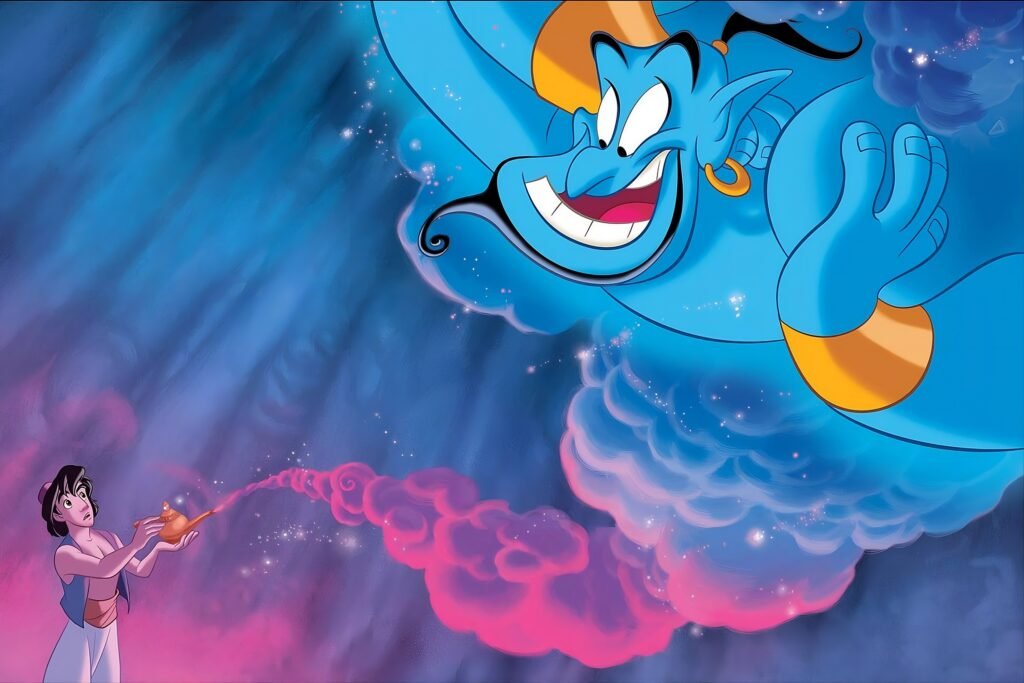
As Nadel notes, American capitalism reconfigures this same fantasy in Disney’s Aladdin, turning royal privilege into consumer pleasure (“A Whole New [Disney] Order World”). The Genie’s colourful transformations and the dazzling visuals equate joy and success with ownership and display, suggesting that happiness can be achieved through acquisition. Like the chapbook, Disney’s retelling replaces genuine social change with magical consumption — the idea that fulfillment can be bought, wished for, or performed.
Aladdin endures because its unstable origins make it the perfect vessel for power. Whether framed by monarchy or capitalism, the story continually rebrands domination as fulfillment, allowing different generations to see their own desires reflected back at them.