Journeault et al. (2021) present a reframed understanding of Hydro-Quebec’s (HQ) sustainability reporting through the Global Reporting Initiative (GRI). The GRI – an institutionally developed technocratic system, predicated on the Western ontology of naturalism that privileges quantitive indicators in HQ’s reports – misrepresents HQ’s sustainability performance. Accordingly, HQ’s reports not only neglect Cree peoples’ animist ontologies in conceptualizing human-nature relations but also fail to transparently portray the harmful social and environmental consequences it poses on Quebec’s Cree community.
Journeault et al. (2021) show that HQ’s reports silence Cree perspectives. Although HQ frames compensation in financial terms, Cree ontology does not perceive living standards and connection to nature in economic terms. HQ’s activities cause major social harms (tradition loss, high dropout rates, diabetes) and environmental damage on nature, animals and Cree life – effects absent from HQ’s reports (Journeault et al., 2021). The extraction of Indigenous lands and natural resources – which lead to the aforementioned consequences – by corporations seeking monetary profit is referred to as extractivism, a modern form of colonial intrusion (Greer, 2020). Although some Indigenous involvement is co-opted through employment or ownership, governments facilitate extraction for profit, concentrating wealth in global centres and perpetuating injustices.
HQ’s failure to provide transparent reports and their negligence of Indigenous ontology is exemplified by the 1971 James Bay Project, an endeavour predicated upon the utilization of Indigenous territory for large-scale energy development. Its emergence can be situated in an era of collective undertakings (The Montreal Metro, Expo 67, Olympic Stadium) that Quebec initiated to gain global recognition as a modernized society (Lacasse, Oct. 1, 2025). Initially founded upon American ideologies of capitalism and neoliberalism, HQ was later reframed as a nationalist symbol of economic reconquest and Quebec sovereignty. This rhetoric shadowed the social and ecological harm that Indigenous communities experienced (Marsh, 2023).
The project resulted in the 1975 James Bay and Norther Quebec Agreement (JBNQA), Canada’s first modern Indigenous land claim treaty. Although the JBNQA established guidelines of land useage, resource usage, monetary compensation, its stipulations parallel Journeault et al.’s (2021) concern: financial compensation cannot eclipse the detrimental effects to Indigenous environment and community. Scholtz’s (2020) paper finds that “the JBNQA is invalid” (p.1). Accordingly, both HQ’s sustainability reports and the JBNQA rest on frameworks that silence Indigenous perspectives and cause detriment while Quebec continues to develops its socioeconomic model.
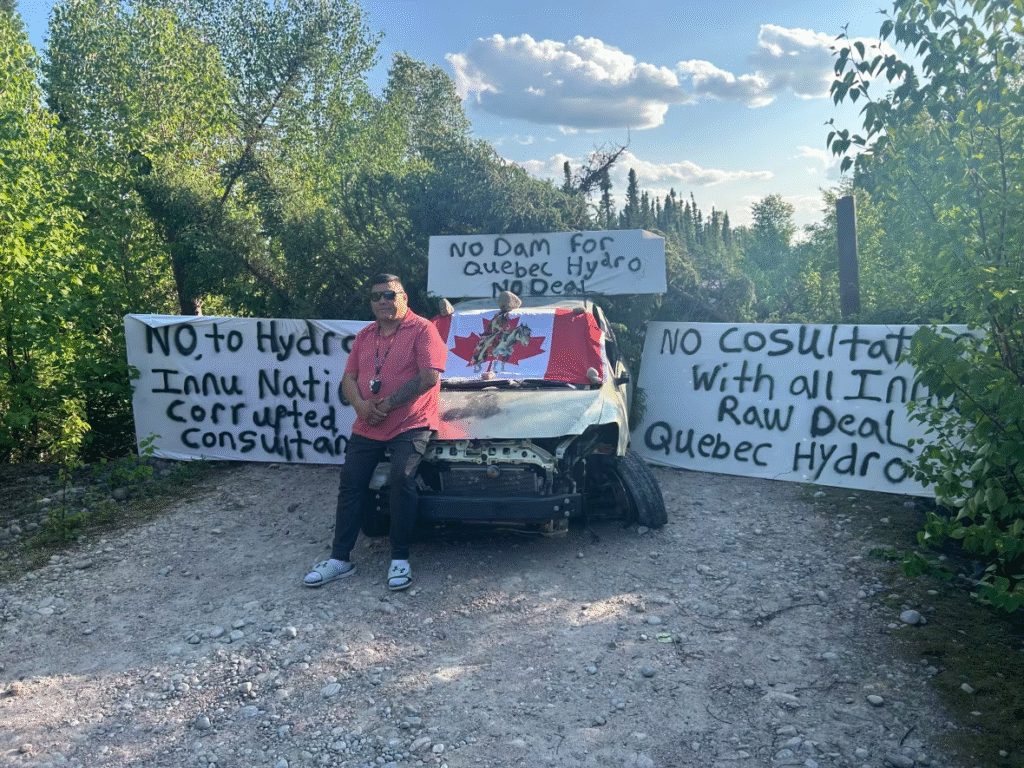
Journeault et al.’s (2021) argument is also illustrated by La Romaine. In January 2025, the Superior Court ordered $5 million in compensation after finding that HQ failed to honor an agreement with the Innu First Nation while developing the La Romaine hydroelectric dam a decade ago (Yanez-Leyton 2025). The Romaine HydroElectric Public Hearing Report highlights serious concerns, such as mercury in fish, mental health impacts, and community disruption, but these were overshadowed by projected economic benefits, which were emphasized as positive for Indigenous Peoples (Canadian Environmental Assessment Agency, 2009). Like the James Bay Project, La Romaine illustrates the pervasiveness of HQ’s extractivism, shadowing consent with economic goals while causing environmental and social disruption. Although HQ was ordered to compensate Indigenous peoples financially, monetary compensation is inconsistent with Indigenous ontology and their relationship to land and community.
An additional issue raised during the hearing concerned the impacts the project would raise on women. The Volet des Femmes Centre, stated “this excellent news will have a positive effect on the social fabric and will (…) lead to the development of new (…) businesses,” failing to clarify how such outcomes would arise (Canadian Environmental Assessment Agency 2009, p.23). This is a direct example of Journeault et al.’s (2021) claims that HQ misrepresents depictions of how projects affect Indigenous communities. Again, economic success overshadowed social and environmental concerns. Importantly, Reese’s (2023) study demonstrating how man camps associated with extractive industries lead to increased rates of sexual assault and human trafficking of Indigenous women, outlining how environmental violence and Indigenous female violence are interconnected.
In sum, Journault et al. (2021) illustrate the systematic oppression of Indigenous communities by HQ in their prioritization of profit, exemplified by the James Bay and La Romaine projects. Indigenous communities continue to face exploitation and environmental, social, and cultural harms, with their concerns repeatedly ignored despite legal interventions or financial compensation.
Bibliography
Canadian Environmental Assessment Agency. (2009). Romaine Hydroelectric Complex Project. Government of Canada and Government of Quebec. https://iaac-aeic.gc.ca/050.
Greer, A. (2019). Settler Colonialism and Beyond. Journal of the Canadian Historical Association, 30(1), 61–86. https://doi.org/10.7202/1070631ar.
Journeault, M., Levant, Y., & Picard, C.-F. (2021). Sustainability performance reporting: A technocratic shadowing and silencing. Critical Perspectives on Accounting, 74. https://doi.org/10.1016/j.cpa.2019.102145.
Lacasse, P. (October 1, 2025). Development and Hydro: Quebec Models [PowerPoint Slides]. Mcgill University, Introduction to Quebec Studies.
Marsh, J. (2023). James Bay Project. In The Canadian Encyclopedia. Retrieved from https:// thecanadianencyclopedia.ca/en/article/james-bay-project.
Reese, Taylor. (2023). You took my land and my body too: the intersectionality of environmental violence against indigenous lands and violence against indigenous women. Journal of Animal & Environmental Law. https://heinonline.org/HOL/Page?handle=hein.journals.
Scholtz, C. (2020). Treaty failure or treaty constitutionalism?: The problematic validity of the James Bay and Northern Quebec Agreement. UNIVERSITY OF TORONTO LAW Journal, 70(3), 306–340.
Yanez-Leyton, C. (2025). Hydro-Québec fined $5M for acting in institutional bad faith toward Innu community. CBC, https://www.cbc.ca/news/canada/montreal/hydro-quebec-fined.